


exibart.es entrevista: Ruanne Abou-Rahme – La poética de la resistencia como práxis
Entrevistas
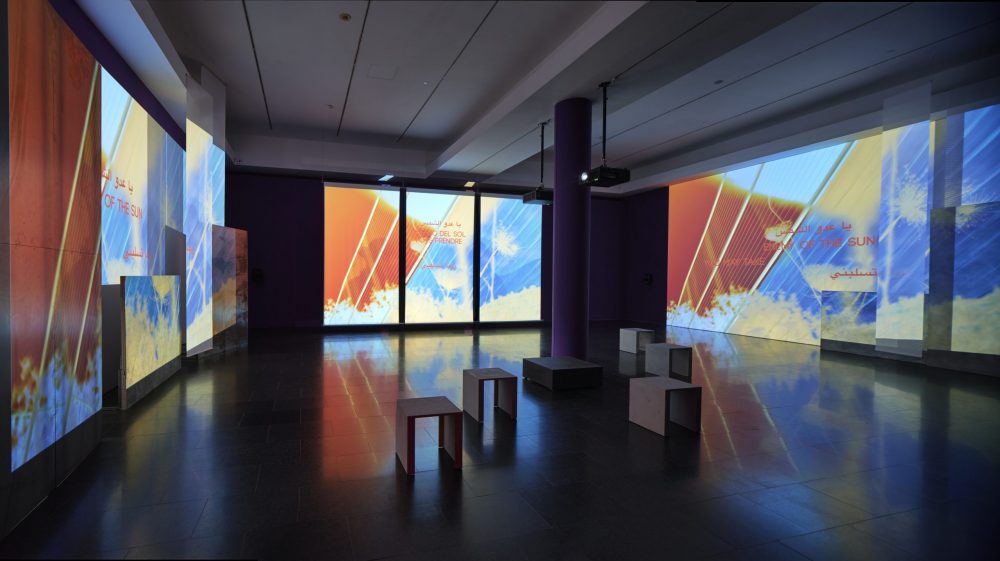
En febrero de este año, el MACBA – Museu d’Art Contemporani de Barcelona presentó la primera exposición en el Estado español de Basel Abbas (Nicosia, Chipre, 1983) y Ruanne Abou-Rahme (Boston, EE. UU., 1983). Bajo la curaduría de Hiuwai Chu, la muestra despliega cerca de dos décadas de colaboración artística marcada por la exploración de la memoria política, los imaginarios de resistencia y el potencial poético del lenguaje audiovisual.
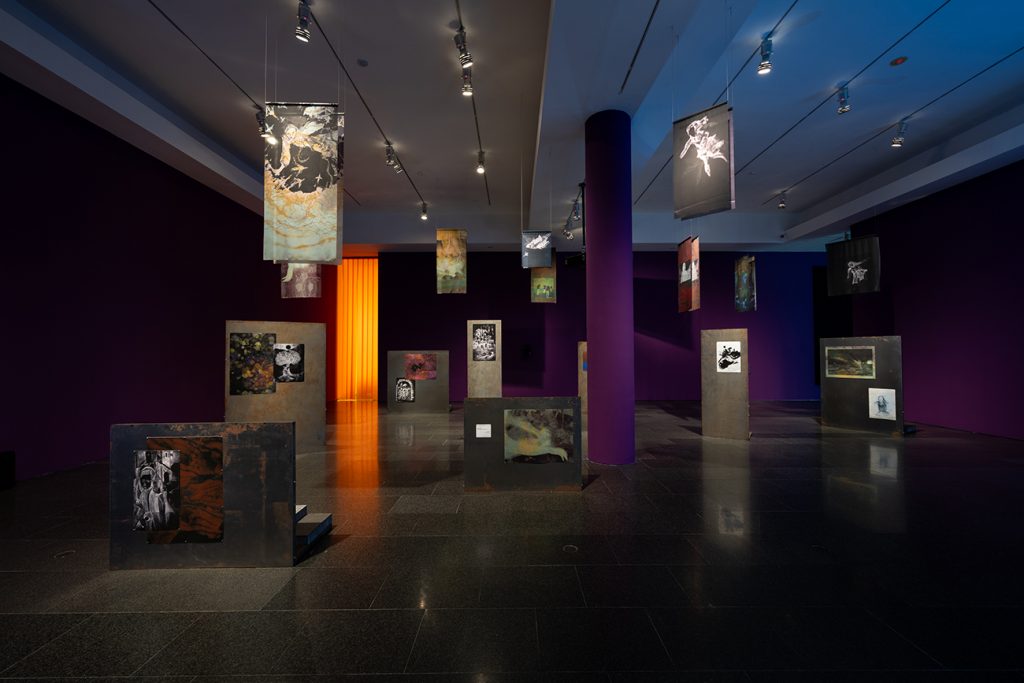
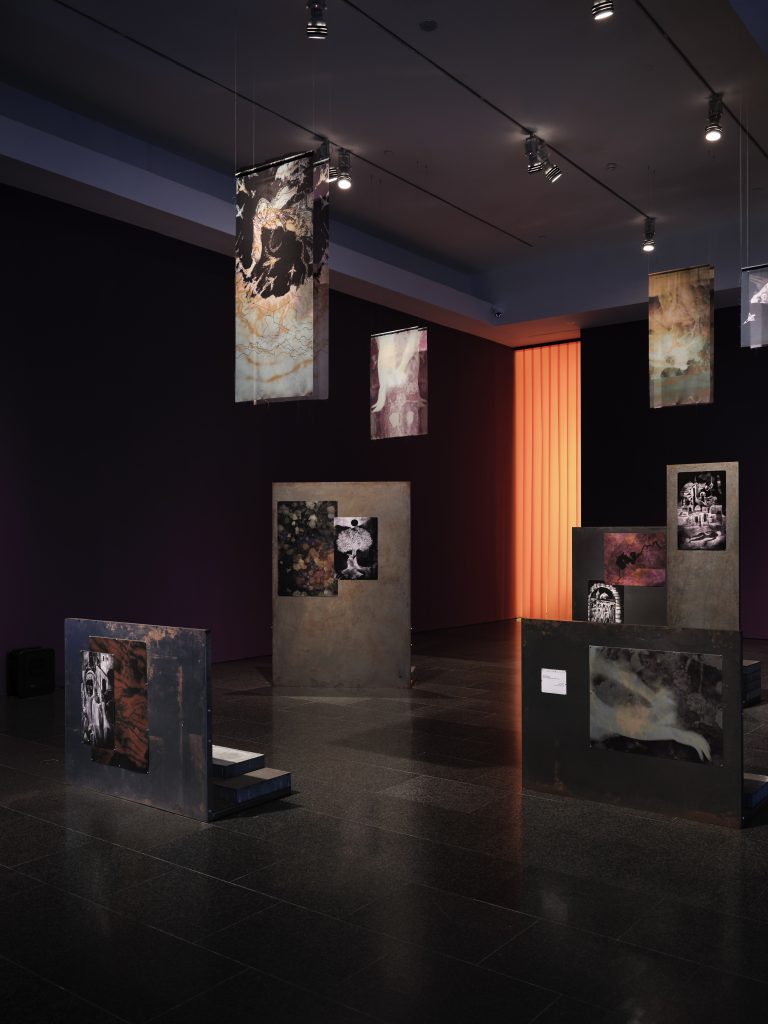
A través de instalaciones, vídeos y archivos intervenidos, el proyecto sitúa al público ante una constelación de obras donde investigación histórica, experiencia afectiva y construcción estética operan como un mismo campo de trabajo. El núcleo de la exposición gira en torno a Prisioneros del amor. Hasta el sol de la libertad, una instalación concebida específicamente para la ocasión que toma como punto de partida la historia de represión del pueblo palestino, desde la Nakba de 1948 hasta la actualidad.
El recorrido incluye también Collapse (2009) —la primera obra colaborativa entre ambxs artistas, construida a partir de fragmentos superpuestos de material de archivo en blanco y negro—, así como Screenshots (2014-en curso) y Desktop Performances (2021-en curso), trabajos que ponen de relieve las condiciones infraestructurales mediante las cuales las imágenes y los sonidos circulan por internet. En todas estas piezas, Abbas y Abou-Rahme indagan en las formas contemporáneas de vigilancia, desaparición y transmisión de la memoria, al tiempo que ensayan otros modos de narrar la experiencia palestina desde la fragmentación, el duelo y la imaginación política.
La exposición llega, además, en un momento en que la violencia contra el pueblo palestino continúa agravándose. Pese a los efímeros acuerdos de alto el fuego, el exterminio en Gaza sigue con la impunidad del silencio internacional, mientras Israel intensifica su política de expansión y violencia en la región, ampliando el alcance del conflicto hacia el Líbano y en el marco de la guerra con Irán. En este contexto, la práctica de Abbas y Abou-Rahme adquiere una resonancia particular: no solo como ejercicio estético, sino también como una forma de preservar relatos, cuerpos y memorias frente a las políticas de borrado.
Esta entrevista a Ruanne Abou-Rahme forma parte, así, de una serie de conversaciones con artistas, comisarixs e investigadorxs palestinxs; un proyecto que busca abrir espacios de escucha y pensamiento crítico frente al silenciamiento mediático (en la misma sección, las entrevistas a Noor Abed y Manar Idrissi).
La conversación se realizó en inglés y fue posteriormente traducida al castellano (la versión original se incluye al final de este artículo). En ella hablamos de archivo y temporalidad, de fragmentación y continuidad, de las posibilidades políticas del lenguaje audiovisual y de cómo sostener prácticas de amor, memoria y resistencia en medio de la violencia colonial. La conversación recorre también las contradicciones del mundo del arte contemporáneo y el lugar del trabajo cultural frente al genocidio en curso en Palestina.
CAROLINA CIUTI: Me gustaría empezar explorando qué os llevó a trabajar juntes. ¿A qué se dedicaba cada une antes de colaborar como dúo y cómo confluyeron vuestras prácticas artísticas individuales en lo que hacéis ahora?
RUANNE ABOU-RAHME: Mi formación está vinculada a la imagen en movimiento y la escritura, mientras que la de Basel se centra en el sonido y la música. Cuando estudiábamos en Londres, ambos empezamos a sentir una profunda frustración respecto a las imágenes y sonidos utilizados para representar Palestina. Esa frustración compartida nos impulsó a intentar reformular su imaginario a través de estrategias estéticas, textuales y sonoras.
También hay que decir que aquel fue un momento de estancamiento en Palestina tras la Segunda Intifada. Se estaba desplegando un proyecto neoliberal y la resistencia anticolonial estaba siendo enterrada. Al mismo tiempo, Palestina comenzaba a aislarse como una cuestión singular, desconectada de las luchas globales. Aquello supuso un cambio significativo, porque en las décadas de 1970 y 1980 Palestina había formado parte de un movimiento más amplio, anticolonial y anticapitalista.
Queríamos repensar esas intersecciones y afinidades, y explorar cómo comprender las injusticias globales a través de Palestina. Eso fue lo que nos unió. Existía una profunda resonancia en nuestra forma de pensar, y la combinación de nuestras prácticas generó una sinergia muy fértil.
CC: Hay un concepto que he encontrado repetidamente en vuestro trabajo: la idea de una «poética de la resistencia». ¿Qué significa para ti la resistencia y en qué sentido vuestra práctica puede entenderse como una «poética de la resistencia»?
RAR: Para mí, la resistencia está profundamente arraigada en las prácticas cotidianas de la gente común. En Palestina, a menudo emerge en los detalles más pequeños. Aunque Palestina tiene una larga historia de lucha armada, Basel y yo nos sentimos especialmente atraídos por formas cotidianas de rechazo y resiliencia que suelen pasar desapercibidas. Estas prácticas forman parte de una lucha anticolonial más amplia y, en conjunto, desempeñan un papel fundamental en la búsqueda de la liberación.
Entonces, ¿qué es la resistencia? Es negarse a aceptar las cosas tal como son. La resistencia es más que mera supervivencia; es la capacidad de generar posibilidad desde condiciones imposibles. Tiene que ver con personas desposeídas que crean grietas o rupturas dentro del sistema, o que hacen surgir algo de la nada, desde la carencia misma. En última instancia, consiste en rechazar un orden hegemónico global que ha decidido que nosotros, como palestinos, somos prescindibles.
En cuanto a la «poética de la resistencia», la poesía ha sido durante mucho tiempo central en la vida cultural palestina y está profundamente entrelazada con la lucha anticolonial, desde la época del Mandato Británico. Sin embargo, en Palestina la poesía no se limita a la página escrita: se improvisa, se comparte y se transmite a través de las canciones. Muchas canciones nacen como poemas improvisados que circulan y se transforman colectivamente a lo largo de generaciones.
En términos generales, lo que hace tan poderosa a la poesía es su capacidad para alterar el lenguaje: fracturarlo y abrir nuevos espacios de pensamiento y de relación con el mundo. A través de esas rupturas, la poesía crea lugar para posibilidades alternativas. Empezamos a pensar esto también en relación con la imagen y el sonido. Ahí es donde surge la idea de una «poética de la resistencia»: cómo podríamos, aunque fuese temporalmente, liberarnos de la captura colonial —no solo de la tierra, sino también del pensamiento y del lenguaje—. La poesía abre ese portal, y a través de él exploramos cómo la imagen y el sonido pueden hacer lo mismo.
CC: Es muy impactante la forma en que describes la fragmentación y la ruptura como espacios de posibilidad. A menudo se nos dice lo contrario: que aquello que está roto o fragmentado simplemente se ha perdido o carece de valor. Esto parece estar muy relacionado con las narrativas coloniales sobre Palestina, que o bien reducen su historia a una ficción o la presentan como demasiado fracturada para contener significado. Me interesa especialmente esta idea de posibilidad dentro de la ruptura, sobre todo en relación con la narración y la reapropiación del tiempo interrumpido, algo que parece central en vuestro trabajo. ¿Podrías desarrollar esa idea?
RAR: Si pensamos en sistemas como el capitalismo racial y el colonialismo, vemos que están profundamente interesados en suspender el presente; producen lo que podríamos llamar un presente amnésico. Esa suspensión es peligrosa porque genera una sensación de repetición interminable, donde los sistemas opresivos prevalecen y el cambio parece imposible. Se convierte en un presente sin futuro.
Por eso ha sido importante para nosotros —y para muchas otras personas— pensar la temporalidad de formas no lineales. Dentro de cualquier momento dado, el pasado sigue desplegándose, mientras que las posibilidades del futuro ya están presentes. Múltiples temporalidades están desarrollándose constantemente, y parte del trabajo consiste en rastrear esas resonancias a través del tiempo.
Últimamente también hemos estado pensando en la deuda: en cómo nuestra capacidad de resistir hoy está moldeada por quienes nos precedieron. El presente está habitado por esas luchas anteriores, por voces y llamados que pueden parecer enterrados, pero que siguen regresando. Puedes sentirlo al leer ciertos textos. Por ejemplo, en Prisoners of Love incluimos un poema escrito en 1957 por el poeta gazatí Muin Bseiso, que fue encarcelado varias veces. Cuando lo lees hoy, parece escrito en la actualidad: su llamado a resistir y perseverar sigue reverberando.
La escritura, en este sentido, se convierte en un espacio donde esos llamados pueden ser escuchados. Mientras que los sistemas capitalistas y coloniales presentan la resistencia como una historia de fracasos, nosotros vemos precisamente su persistencia: su capacidad de reaparecer bajo distintas formas. Parte de nuestro papel como trabajadores culturales consiste en reactivar esos textos y voces anteriores: traerlos al presente, permitir que se muevan con nosotros y transportarlos hacia adelante.
Esto es central en nuestra manera de pensar la no linealidad: rechazar la idea de un presente suspendido y apocalíptico. Hay cierta fuerza en reconocer que quienes vinieron antes siguen estando con nosotros a través de historias, textos y canciones. Nuestra tarea, entonces, consiste en mantener vivas esas formas: activarlas y hacerlas circular para que puedan resonar, expandirse y volver a ser retomadas en otros lugares.
CC: Tanto Noor Abed como Manar Idrissi —a quienes también he entrevistado para esta sección— hablaron sobre la importancia de cultivar un sentido de continuidad como forma de interrumpir la sensación de alienación respecto al tiempo. Como mencionabas, es importante reconocer lo que vino antes, reconocer genealogías. En vuestra práctica, siento que esto también está relacionado con la centralidad del archivo. ¿Podrías profundizar en ello?
RAR: Para mí, el archivo —o más bien nuestra forma de entender el archivo— se sitúa en oposición a la concepción colonial occidental del mismo. No se trata simplemente del pasado; también abarca aquello que está sucediendo y permanece vivo en el presente.
Como decía al principio de esta conversación, nos interesan especialmente las prácticas cotidianas de las personas: esos actos generativos de resistencia que se despliegan día a día. Desde antes de 1948, el proyecto sionista ha intentado sistemáticamente borrar los archivos palestinos, tanto del pasado como del presente, como parte de un intento más amplio de erradicar la esencia misma de un pueblo. Incluso ahora, en medio del genocidio, existen esfuerzos por eliminar los vídeos e imágenes que han surgido como documentos durante los últimos tres años.
Para nosotros es crucial pensar cómo la gente se enfrenta a ello, ya sea a través de la poesía, la música, la danza o cualquier otro ritual cotidiano, gesto o acto de resistencia. Trabajamos junto a esas prácticas: aprendiendo de ellas, honrándolas, amplificándolas y contribuyendo, a nuestra manera, a resistir el borrado colonial sistémico.
Este trabajo adopta muchas formas. Con el proyecto Prisoners of Love, por ejemplo, la exposición es solo un elemento. También estamos construyendo una gran base de datos desarrollada colectivamente con los materiales que hemos reunido, con el objetivo de crear un recurso para la comunidad y para otras personas implicadas en luchas por la liberación. Intentamos crear obras que operen a través de múltiples formatos y sirvan como recursos para comunidades, aquí y en otros lugares, comprometidas en luchas continuas por liberarse de un sistema que nos está matando a nosotros y al planeta.
CC: La exposición en MACBA parece reunir todo esto de manera muy efectiva. Esto se percibe no solo en la instalación site-specific Prisoners of Love, sino también en las demás obras. Existe una fuerte sensación de que el punto de partida no es vuestra experiencia individual como artistas palestinxs, sino más bien un cuerpo compartido de conocimiento, arraigado en lo ordinario y en lo cotidiano.
¿Podrías hablar sobre cómo concebisteis la exposición? ¿Cómo decidisteis qué obras incluir —especialmente Collapse, que entiendo que fue vuestra primera colaboración cinematográfica—? ¿Y cuál es la conexión entre ese trabajo temprano y vuestra práctica más reciente?
RAR: Hicimos Collapse en un momento en el que sentíamos que no podíamos filmar en Palestina. Nos llevó muchos años llegar a un punto en el que sintiéramos que podíamos hacerlo. Ese cambio implicó un largo proceso de cuestionamientos y conversaciones. Al mirar hoy aquella primera obra junto a Prisoners of Love y las Desktop Performances, se puede trazar una evolución muy clara y, al mismo tiempo, percibir una serie de continuidades.
Existe, por ejemplo, un interés persistente por el fragmento, por trabajar con formas parciales. También hay una atención constante al sonido: pensar el ritmo como base de la resistencia. En ese sentido, muchas de las semillas ya estaban presentes en las primeras obras, aunque también haya rupturas significativas. Yo misma sigo intentando entender esas conexiones y me interesa ver cómo las interpretan otras personas.
En cuanto a la exposición en sí, la configuración espacial del MACBA fue crucial. El espacio consta de cuatro salas conectadas por un pasillo y, durante la visita técnica, aquello nos hizo pensar inmediatamente en celdas de prisión; concretamente, en cómo los presos liberados describen las celdas conectadas por pasillos, y cómo el sonido y el texto viajan entre ellas. Eso se convirtió en la base de una obra concebida ad hoc para el espacio, pensando en cómo el sonido y el texto podrían atravesar temporalmente los muros de la prisión. De hecho, en la cárcel nada sucede de forma aislada: ya sea cantar o escribir, todo está moldeado por un espíritu colectivo y por esfuerzos compartidos. Estas prácticas resisten la lógica que busca atomizar a los individuos.
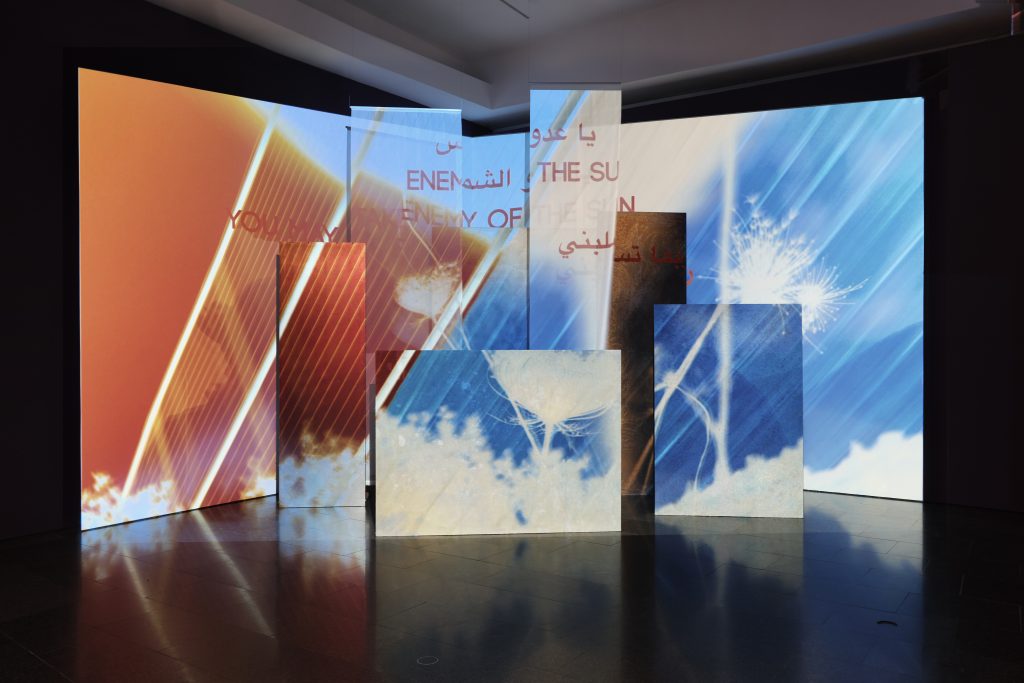
La obra también se inspira en el poema Enemy of the Sun, y la instalación en su conjunto —titulada So that we may rupture a sky with no sun— dialoga con el simbolismo del sol y de su ausencia mediante gradaciones de amarillo y naranja. Una de las referencias aquí es la historia de George Jackson y cómo un poema escrito en una prisión israelí en Palestina llegó a circular en la prisión de San Quentin. Durante décadas, dentro de la tradición radical de los Black Panthers en Estados Unidos, el poema fue atribuido a George Jackson, cuando en realidad había sido escrito por Samiha al-Qasim. Fue el investigador Greg Thomas quien descubrió esta historia. Para nosotros, no se trata simplemente de un caso de atribución errónea; es un poderoso ejemplo de conexión y afinidad, de cómo la resistencia circula y dialoga entre contextos distintos.
Al mismo tiempo, incluimos Screenshots y Desktop Performances para mostrar otra capa más: una especie de genealogía de cómo pensamos la escritura y el sonido a través de diferentes contextos. También existe un contraste formal. Las obras de vídeo y sonido, así como las instalaciones, están muy compuestas y cuidadosamente editadas, mientras que las Desktop Performances son más sueltas e inmediatas. Nos interesaba esa tensión.
Más ampliamente, en Prisoners of Love trabajamos con materiales como el hormigón y el acero —materiales rígidos, «coloniales»—, pero también con tejidos porosos que permiten que las imágenes atraviesen y excedan su superficie. Existe una especie de dialéctica entre aquello que está cerrado, sellado e irrespirable y aquello que permite filtraciones, visibilidad y tránsito.
Si pensamos la prisión no solo como un espacio físico, sino como una lógica más amplia vinculada al colonialismo y al capitalismo, entonces estas cuestiones van mucho más allá de Palestina. Nos devuelven a la necesidad de otro imaginario político y de otro lenguaje visual. Formalmente, es algo que nos preguntamos constantemente: ¿cómo podría la distorsión —a través de superposiciones, transparencias o fragmentaciones— permitir que algo diferente se vuelva visible?
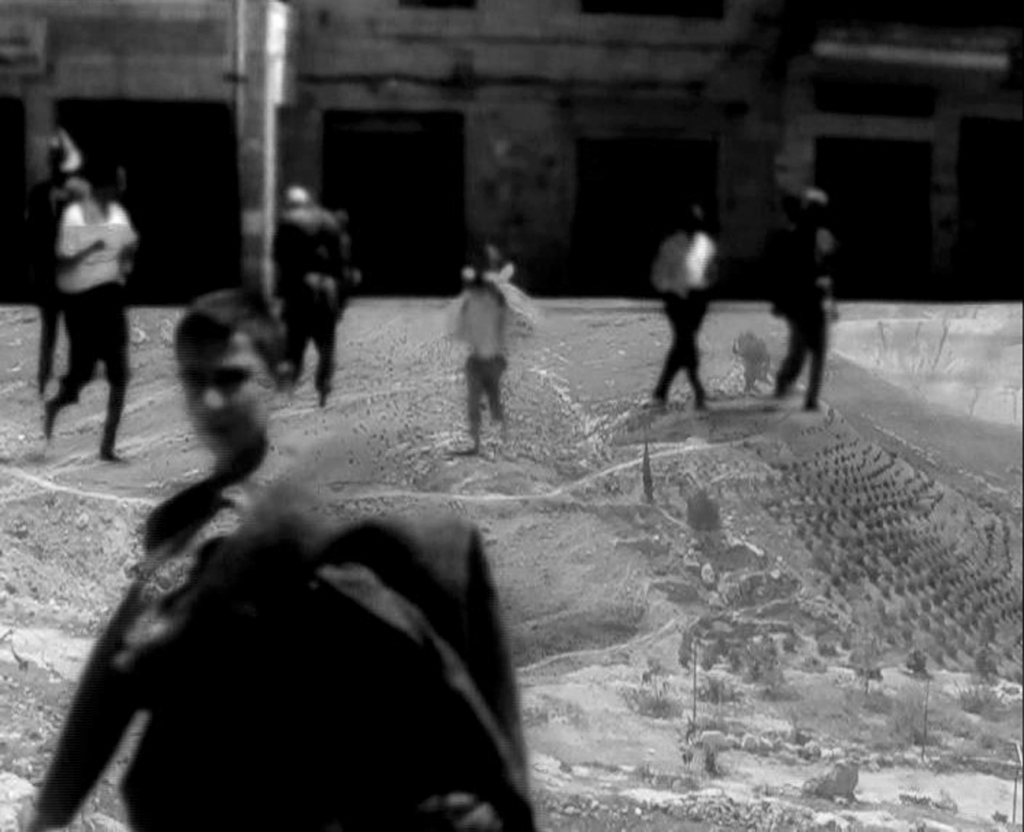
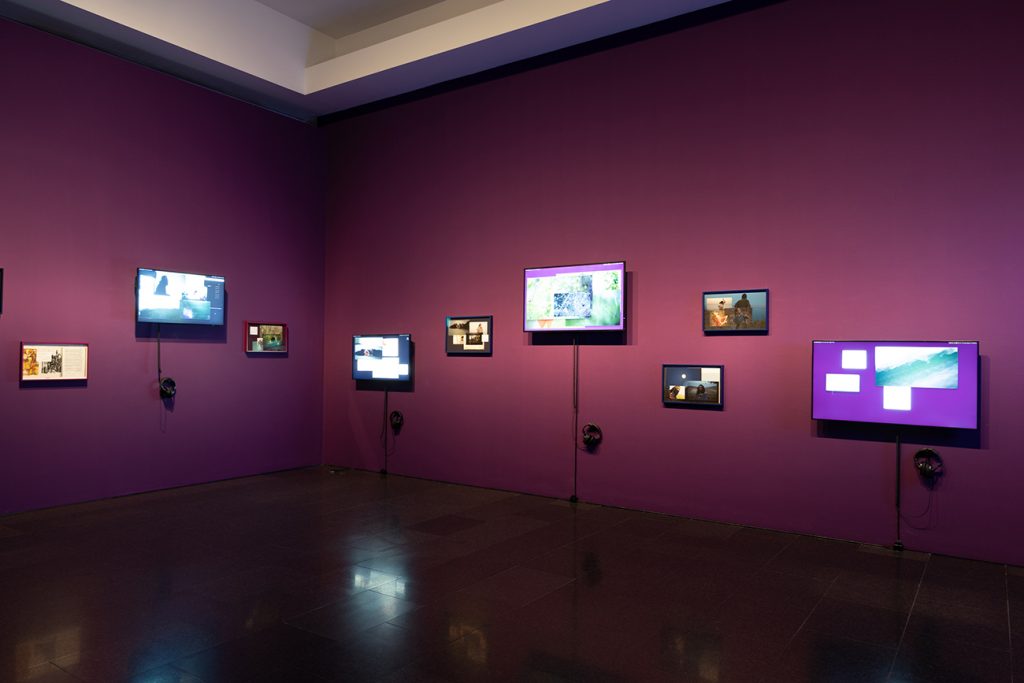
CC: Dentro de la exposición, las obras más tempranas podrían parecer inicialmente desconectadas de las más recientes, aunque, como señalas, existe una fuerte relación entre ellas. Resulta muy llamativo observar cómo evolucionan las imágenes —desde algo más crudo hacia algo más escenificado y teatral— manteniendo, sin embargo, un enfoque centrado en la construcción de un imaginario político diferente.
En ese sentido, me gustaría profundizar en vuestro trabajo más reciente, Prisoners of Love: Until the Sun of Freedom, coproducido para la exposición por varias instituciones artísticas occidentales. Me pregunto si erais conscientes de ese contexto mientras lo realizabais y si influyó en vuestro enfoque.
RAR: Para nosotros era importante qué instituciones estaban encargando la obra. Necesitábamos sentir que tenían una postura clara y de principios respecto a Palestina. Esa fue una condición desde el principio.
Al mismo tiempo, cuando se trata de crear la obra en sí, Basel y yo imaginamos siempre, en primer lugar, a un público palestino. Eso no significa que la obra sea solo para palestinos —es para todo el mundo—, pero es importante para nosotros que los palestinos sientan que les habla directamente. Si se parte de la perspectiva de un público occidental, con la necesidad de explicarlo todo, entonces la obra corre el riesgo de perder algo esencial. Los palestinos no necesitan esas explicaciones; necesitan algo que resuene de manera más directa.
En ese sentido, a menudo pienso esta obra como una especie de carta de amor, una canción de amor para los prisioneros, para la tierra y para un pueblo que sigue resistiendo. Durante el proceso, las primeras personas con las que compartimos el trabajo fueron miembros de nuestra comunidad palestina, y era fundamental para nosotros que se sintieran conmovidos, que sintieran que la obra era significativa y auténtica para ellos.
Creo que, si partes de un lugar honesto y arraigado, la obra puede viajar y traducirse a otros contextos. Por supuesto, algunos elementos quizá no sean plenamente comprendidos por todos los públicos, pero el impulso general de la obra —el llamado que plantea— puede sentirse si uno está abierto a ello, independientemente de desde dónde venga.
CC: También me gustaría preguntarte por la presencia del amor y de la alegría en la obra. La instalación es profundamente conmovedora y está arraigada en historias dolorosas, especialmente si se piensa en la situación actual y en las condiciones que enfrentan los prisioneros palestinos. Y sin embargo, también genera una sensación de alegría; yo misma experimenté una emoción alegre mientras habitaba el espacio.
Esto me recordó a un vídeo de la activista palestina Bisan Owda, en el que reflexiona sobre la sensación de alegría tras el primer llamado «alto el fuego». Habla de sentir alegría, pero también de la dificultad para expresarla, por miedo a que otros puedan poner en duda la realidad del sufrimiento en Palestina. Me interesa saber cómo pensáis esa tensión: la recuperación de la alegría y del amor dentro de un contexto así.
RAR: Para nosotros eso es fundamental. La obra está profundamente preocupada por la pregunta de por qué la gente resiste, y esa pregunta siempre está arraigada en el amor: por la tierra, por la comunidad. Es una fuerza profunda y sostenedora. Cada persona encarcelada ha sacrificado muchísimo movida por ese amor, y nosotros sentimos una profunda deuda hacia ellas.
En Palestina, la resistencia no se articula únicamente en términos ideológicos; se vive y se siente a través de ese profundo apego a la vida y a los demás. Eso es algo que queríamos honrar en la obra. Incluso durante el proceso de creación —estar juntos en la tierra, muchas veces en lugares amenazados— hubo momentos de conexión muy profunda.
La obra existe dentro de esa tensión: hay dolor, pérdida y duelo, pero también una insistencia en la vida, expresada a través del amor y la alegría. La cultura palestina siempre ha sostenido ambas cosas: la alegría no como negación del sufrimiento, sino como una forma de resistencia en sí misma. Al mismo tiempo, existe una profunda capacidad para expresar el dolor y la angustia; no se perciben como opuestos, sino como realidades coexistentes.
A veces, desde fuera, esa coexistencia puede resultar difícil de interpretar: si la alegría es o no «apropiada» en esas condiciones. Pero para nosotros es esencial. Hay alegría, por ejemplo, en las formas en que los prisioneros resisten: cantando, escribiendo, dibujando. Esos gestos son extraordinarios y afirman la vida en las condiciones más imposibles.
En última instancia, esta es una lucha por la vida. Sin ese amor y esa alegría, la gente quedaría destruida. Así que no se trata de elegir una cosa u otra; ambas existen juntas y se alimentan mutuamente. Eso es también lo que intentamos sostener en la obra: momentos de dificultad y violencia junto a momentos de insistencia, conexión y posibilidad.
Añadiré una última reflexión. Mientras trabajaba en la sección dedicada a Enemy of the Sun, estaba leyendo cartas de prisioneros que hablaban de seguir resistiendo «hasta el sol de la libertad». Y entonces, un día, ocurrió el martirio del periodista Anas al-Sharif; en su testamento aparecían exactamente esas palabras. Fue un momento devastador, pero también uno que me hizo sentir la continuidad de ese llamado. Para mí, el «sol de la libertad» es precisamente esta idea de amor y alegría: apunta a la posibilidad de un mundo diferente, no definido por la violencia colonial y capitalista, sino por otra manera de estar juntos.
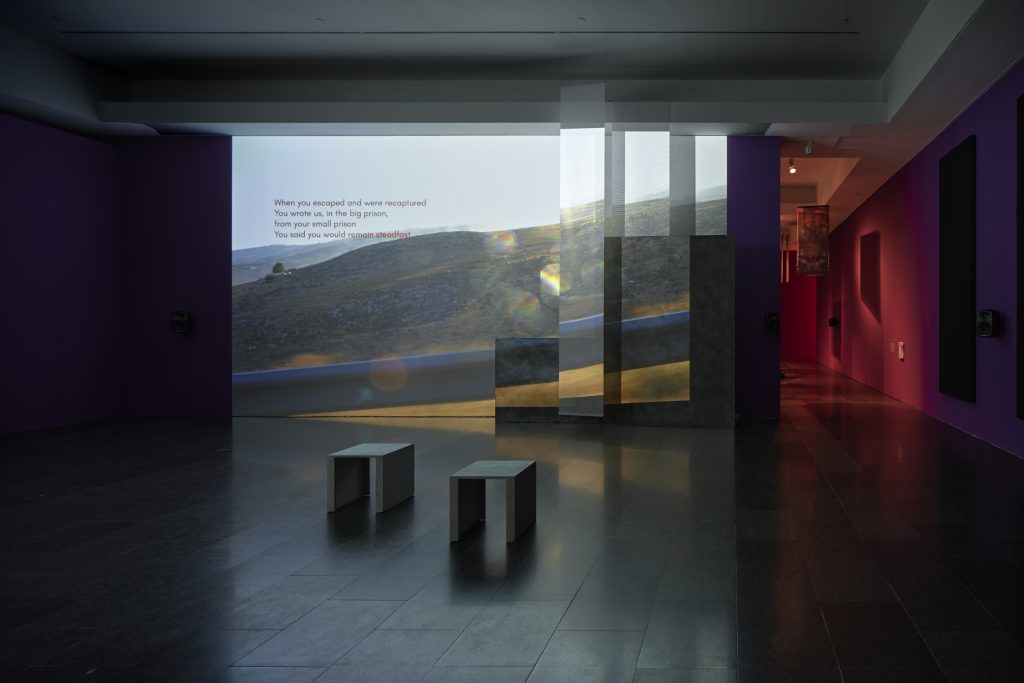
CC: Creo que lo que dices sobre la dualidad y la necesidad de sostenerlo todo al mismo tiempo se refleja maravillosamente en vuestra película multicanal en el MACBA: a veces los textos y diálogos son directos, mientras que en otros momentos se vuelven líricos y poéticos. La música también refleja esto: en ocasiones recuerda a una nana y en otras adquiere un carácter muy rítmico.
Tengo una última pregunta sobre la responsabilidad, algo que has mencionado a lo largo de toda esta conversación: tanto vuestra responsabilidad hacia vuestra comunidad como hacia Occidente, donde vivís actualmente. ¿Cómo gestionáis esa responsabilidad? ¿Habéis vivido alguna vez una crisis al intentar expresarla a través del arte —sentir que lo que hacíais no era suficiente o cuestionaros vuestro papel como artistas en relación con esa responsabilidad?
RAR: Creo que es una pregunta importante. Por supuesto, ha habido momentos en los que me he sentido así. Pero debo decir que las exposiciones son solo una parte del trabajo cultural que hacemos. También formamos parte de un colectivo editorial: publicamos libros y música, y realizamos mucho trabajo fuera de esas estructuras visibles, un trabajo profundamente arraigado en la comunidad.
Eso no es algo que suela hacer público, precisamente porque no quiero que el mundo del arte lo instrumentalice o lo convierte en un fetiche, en algo que simplemente otorgue valor añadido a Basel y a mí. Odio esa lógica.
Sí, ha habido momentos de cuestionamiento, especialmente porque encuentro el mundo del arte extremadamente tóxico. Está impulsado por lógicas de mercado, y muchas instituciones en Estados Unidos están gobernadas por algunas de las mismas personas contra las que luchamos. Y entonces te encuentras exponiendo en esas instituciones. Es extremadamente difícil y nunca es algo sencillo. La cuestión de participar o no debe considerarse cada vez de manera muy específica: ¿es estratégicamente correcto hacerlo?
Con instituciones como esas, a menudo siento que participo en una especie de guerra. ¿Es importante ocupar ese espacio y tener allí la obra, aun sabiendo que la propia infraestructura del museo puede ser terrible? Son preguntas muy difíciles.
Intento dejarme guiar por mi comunidad. No son decisiones que tome sola; hablamos con muchas personas de la comunidad cuando surgen estas cuestiones. Y creo que es muy importante decir que el trabajo cultural —cuando está comprometido con un proyecto de liberación— importa. Es importante y supone una amenaza.
Si algo ha dejado claro el genocidio en Palestina es precisamente eso. Artistas, escritores y periodistas han sido sistemáticamente atacados. Esto no es nuevo: incluso antes del genocidio, los trabajadores culturales eran encarcelados constantemente. El genocidio simplemente expuso la gravedad horrorosa de esa violencia, porque en lugar de encarcelar a la gente, comenzaron a atacarla y asesinarla directamente.
Esa realidad demuestra que la idea neoliberal de que el arte es simplemente «arte por el arte», sin fuerza política ni consecuencias, es falsa. Cuando la práctica cultural está verdaderamente comprometida con la liberación —ya sea en Palestina, en Estados Unidos o en cualquier otro lugar— importa.
La lógica de la violencia genocida no consiste únicamente en matar personas; también consiste en matar ideas. Busca destruir espacios de resistencia, silenciar voces que dicen: no, nos negamos. Por eso cargamos con una gran responsabilidad, una responsabilidad con la que debemos comprometernos y volver a comprometernos constantemente. Para mí, esto también implica rechazar la lógica del mercado artístico neoliberal y aquellos aspectos del mundo del arte que intentan desactivar la práctica cultural, volverla inofensiva o vacía, cuando en realidad puede ser poderosa, incisiva y necesaria.
Hago esto sin ninguna ilusión de que ciertas instituciones artísticas vayan a cambiar fundamentalmente. No creo que las instituciones estadounidenses vayan a transformarse por sí solas. Necesitamos construir nuestros propios espacios, invertir en crear estructuras colectivas, nuevas redes y diferentes maneras de hacer circular, compartir y amplificar el trabajo cultural, sin tener siempre que pasar por canales institucionales.
CC: Muchísimas gracias por esta conversación. En unos días viajaré a Venecia para La Biennale y tus palabras me reconfortan. Aunque iré para apoyar al trabajo de un artista y un comisario que admiro profundamente, el contexto general me enfurece, especialmente pensando en cómo la presidencia de la institución ha decidido actuar respecto a la participación de Israel y Rusia.
RAR: Es repugnante. Toda la situación con el pabellón israelí —trasladarlo, no utilizarlo— no es más que un lavado de imagen. Es grotesco. Cada día están matando gente. Ayer mataron a decenas de personas, incluida la periodista Amal Khalil. Primero resultó herida y no permitieron que nadie la ayudara. Murió tras horas de abandono. Y aun así, la Bienal no dudó en proporcionar a Israel un pabellón alternativo mientras supuestamente restauraban el suyo. Todo ha alcanzado un nivel grotesco.
Por eso es crucial que la gente actúe, que interrumpa. Pero esta es también la lógica del mercado. Nos produce no como trabajadores culturales, sino como individuos aislados y egocéntricos. El mercado del arte fomenta estructuralmente el interés personal.
Tenemos que luchar contra eso. El trabajo cultural debe entenderse de otra manera, y necesitamos inspirar a la gente para que salga de la prisión mental construida alrededor de la protección de las carreras profesionales. Las carreras no significan nada frente al auge del fascismo global, la violencia colonial desatada y el poder descontrolado del capital. La descolonización y el arte político no son teóricos: son prácticos. Ahora es el momento de la praxis. Tenemos que ser combativos, alzar la voz y desafiar a la gente. No debemos tener miedo.
_____________________________________________________
VERSIÓN ORIGINAL DE LA CONVERSACIÓN EN INGLÉS:
CAROLINA CIUTI: I’d like to start by exploring what brought the two of you to work together. What were you each doing before collaborating as a duo, and how did your individual artistic practices merged into what you’re doing now?
RUANNE ABOU-RAHME: My background is in moving image and writing, while Basel’s is in sound and music. When we were studying in London, we both grew frustrated with the images and sounds used to represent Palestine. This shared frustration drove us to try and reformulate its imaginary through aesthetic, textual, and sonic strategies.
It must be said that this was also a moment of stagnation in Palestine after the Second Intifada. A neoliberal project was unfolding, and anti-colonial resistance was being buried. At the same time, Palestine was being isolated as a singular issue, disconnected from global struggles. This marked a significant shift, as in the 1970s and 1980s, Palestine had instead been part of a broader anti-colonial, anti-capitalist movement.
We wanted to rethink those intersections and kinships and explore how we could understand global injustices through Palestine. That’s what brought us together. There was a deep resonance in our thinking, and combining our practices created a generative synergy.
CC: There’s a concept I’ve come across multiple times in your work: the idea of a “poetics of resistance”. What does resistance mean to you, and how does your work unfold into a poetics of resistance?
RAR: For me, resistance is deeply rooted in the everyday practices of ordinary people. In Palestine, it often emerges in the smallest details. While Palestine has a long history of armed struggle, Basel and I are especially drawn to overlooked forms of daily refusal and resilience. These practices are part of a broader anti-colonial struggle and, collectively, they play a vital role in the pursuit of liberation.
So, what is resistance? It’s the refusal to accept things as they are. Resistance is more than just survival; it’s the ability to generate possibility from within impossible conditions. It’s about dispossessed people creating breaks or ruptures within the system, or making something from nothing, from within the lack. Ultimately, it’s about rejecting a hegemonic global order that has decided we, as Palestinians, are disposable.
As for the “poetics of resistance,” poetry has long been central to Palestinian cultural life and is deeply intertwined with anti-colonial struggle, dating back to the British Mandate. Yet, in Palestine, poetry is not confined to the page—it is improvised, shared, and carried through songs. Many songs originate as improvised poems that are passed along and reshaped collectively and across generations.
In general, what makes poetry so powerful is its ability to disrupt language—to fracture it and open new spaces of thinking and being with the world. Through these breaks, poetry creates room for alternative possibilities. We began to think about this in relation to image and sound as well. This is where the idea of a “poetics of resistance” emerges: how we might, even temporarily, free ourselves from colonial capture—not only of land, but of thought and language. Poetry opens that portal, and through it, we explore how image and sound can do the same.
CC: The way you describe fragmentation and rupture as spaces of possibility is striking. We’re often told the opposite—that what is broken or fragmented is simply lost or without value. This feels closely tied to colonial narratives about Palestine, which either reduce its history to fiction or present it as too fractured to hold meaning. I’m particularly interested in this idea of possibility within rupture, especially in relation to storytelling and the reappropriation of disrupted time, which seems central to your work. Could you expand on that?
RAR: If we think about systems like racial capitalism and colonialism, they are deeply invested in suspending the present—producing what you might call an amnesiac present. This suspension is dangerous because it creates a sense of endless repetition, where oppressive systems prevail and change feels impossible. It becomes a present without futurity.
That’s why it has been important for us, as for many others, to think about temporality in non-linear ways. Within any given moment, the past is still unfolding, while possibilities for the future are already present. Multiple temporalities are constantly unfolding, and part of the work is to trace these resonances across time.
Lately, we’ve also been thinking about indebtedness—how our capacity to resist today is shaped by those who came before us. The present is inhabited by these earlier struggles, by voices and calls that may seem buried but continue to return. You can feel this when reading certain texts. For example, in Prisoners of Love, we include a poem written in 1957 by the Gazan poet Muin Bseiso who was imprisoned multiple times. When you read it now, it feels as though it could have been written today—its call to endure and resist still reverberates.
Writing, in this sense, becomes a space where these calls can be heard. While capitalist/colonial systems frame resistance as a history of failure, what we see instead is its persistence—its capacity to reappear in different forms. Part of our role as cultural workers is to reactivate these earlier texts and voices: to bring them into the present, to let them move with us, and to carry them forward.
This is central to how we think about non-linearity—refusing the idea of a suspended, apocalyptic present. There is strength in recognising that those who came before us are still, with us, through stories, texts, and songs. Our task, then, is to keep these forms alive—to activate and circulate them so they can resonate, expand, and be taken up again elsewhere.
CC: Both Noor Abed and Manar Idrissi—whom I’ve also interviewed for this section—spoke about the importance of nurturing a sense of continuity as a way to disrupt the feeling of alienation from time. As you mentioned, it’s significant to recognise what came before us, to acknowledge genealogies. In your practice, I feel this also ties into the centrality of the archive: could you expand on that?
RAR: For me, the archive—or rather, how we think about the archive—stands in opposition to the Western colonial conception of it. It is not simply about the past; it encompasses what is happening and alive in the present.
As I said at the beginning of this conversation, we are particularly interested in people’s daily practices—the generative acts of resistance that unfold everyday. Since before 1948, the Zionist project has consistently sought to erase Palestinian archives, both past and present, as part of a broader attempt to eradicate the essence of a people. Even now, amid the ongoing genocide, there are efforts to erase the videos and images that have emerged as documents over the past three years.
For us it is crucial to consider how people are countering this–be it through poetry, music, dance, or any other sort of daily rituals, gestures and acts of resistance. We work alongside these practices: learning from them, honouring them, amplifying them, and contributing in our own way to resisting systemic colonial erasure.
This work takes many forms. With the Prisoners of Love project, for instance, the exhibition is only one element. We are also building a large, collectively developed database of the materials we have gathered, with the aim of creating a resource for the community and for others engaged in struggles for liberation. We try to create work that operates across forms and serves as a resource for communities, here and elsewhere, engaged in ongoing struggles for liberation from a system that is killing us and the planet.
CC: The exhibition at MACBA seems to bring all of this together very effectively. This is evident not only in the site-specific installation Prisoners of Love, but also in the other works. There is a strong sense that the point of departure is not your individual experience as Palestinian artists, but rather a shared body of knowledge, grounded in the ordinary and the everyday.
Could you speak about how you conceived the exhibition? How did you decide what to include—particularly what I understand to be your first film collaboration, Collapse? And what is the connection between that earlier work and your more recent practice?
RAR: We made Collapse at a time when we felt we couldn’t film in Palestine. It took us many years to reach a point where we felt able to do that. That shift involved a long process of questioning and conversation. Looking back at that first work alongside Prisoners of Love and the desktop performances, you trace a clear evolution and yet still see a set of continuities.
There is, for instance, an ongoing interest in the fragment, in working with partial forms. There’s also a sustained engagement with sound—thinking about rhythm, and rhythm as a basis for resistance. In that sense, many of the seeds are already present in the earlier work, even if there are significant departures. I’m still figuring out how I understand those connections myself, and I’m curious how others read them.
As for the exhibition itself, the spatial configuration at MACBA was crucial. The space consists of four rooms connected by a corridor, and during the site visit it immediately made us think of prison cells—specifically, how liberated prisoners describe cells as being connected through corridors, and how sound and text travel between them. That became the basis for a site-specific work, thinking about how sound and text might temporarily breach the prison walls. In fact, in prison nothing happens in isolation—whether it’s singing or writing, everything is shaped by a collective spirit and efforts. These practices resist the logic that seeks to atomise individuals.
The work also draws on the poem Enemy of the Sun, and the installation as a whole—titled So that we may rupture a sky with no sun—engages with the symbolism of the sun and its absence, through gradations of yellow and orange. One of the references here is the story of George Jackson, and how a poem written in an Israeli prison in Palestine came to circulate in San Quentin Prison. For decades, the poem was understood within the Black Panther’s radical tradition in the United States as belonging to George Jackson, when in fact it was written by Samiha al-Qasim. It was the researcher Greg Thomas who uncovered this history. For us, this is not simply a case of misattribution—it’s a powerful example of connection and kinship, of how resistance circulates and speaks across contexts.
At the same time, we included the Screenshots and Desktop Performances to show yet another layer—a kind of genealogy of how we think through writing and sound across different contexts. There’s also a formal contrast. The video and sound works, and the installations, are very composed and tightly edited, whereas the Desktop Performances are looser, more immediate. We were interested in that tension.
More broadly, in Prisoners of Love, we work with materials like concrete and steel—these rigid, “colonial” materials—but also with fabrics that are porous, that allow images to travel through and extend beyond their surface. There’s a kind of dialectic between what is closed, sealed, and unbreathable, and what allows for seepage, for visibility, for passage.
If we think of the prison not just as a physical space but as a broader logic—one tied to colonialism and capitalism—then these questions extend far beyond Palestine. They return us to the need for a different political imaginary, and a different visual language. Formally, this is something we’re always asking: How might distortion—through layering, transparency, or fragmentation—allow something else to become visible?
CC: Within the exhibition, the earlier works might initially seem disconnected from the more recent ones, yet, as you mentioned, there is a strong relationship between them. It’s striking to see how the images evolve—from something raw to something more staged and theatrical—while still sustaining a focus on the construction of a different political imaginary.
In that sense, I’d like to delve further into your most recent work, Prisoners of Love: Until the Sun of Freedom, which was co-produced for the exhibition by several Western art institutions. I’m wondering whether you were conscious of that context while making it, and whether it shaped your approach.
RAR: It was important to us which institutions were commissioning the work. We needed to feel that they had a clear and principled position on Palestine. That was a condition for us from the outset.
At the same time, when it comes to making the work itself, Basel and I always imagine a Palestinian audience first. That doesn’t mean the work is only for Palestinians—it’s for everyone—but it’s important to us that Palestinians feel that it speaks to them. If you begin from the perspective of a Western audience, with the need to explain everything, then the work risks losing something essential. Palestinians don’t need those explanations; they need something that resonates more directly.
In that sense, I often think of this work as a kind of love letter—a song of love for the prisoners, for the land, and for a people who continue to resist. During the process, the first people we shared the work with were members of our Palestinian community, and it was crucial for us that they felt moved by it, that it felt meaningful and true to them.
I think that if you begin from that place—something honest and grounded—the work can then travel and translate across contexts. Of course, some elements might not be fully grasped by all audiences, but the broader impulse of the work—the call it makes—is something that can be felt if one is open to it, regardless of where one is coming from.
CC: I’d also like to ask about the presence of love and joy in the work. The installation is deeply moving and rooted in painful histories—especially when considered in relation to the current situation and the conditions faced by Palestinian prisoners. And yet, it also generates a sense of joy; I found myself experiencing a moving joy while inhabiting the space.
This brought to mind a video by Palestinian activist Bisan Owda, in which she reflects on the feeling of joy after the first so-called “ceasefire.” She speaks about feeling joy, but also about the difficulty of expressing it, for fear that it might lead others to doubt the reality of suffering in Palestine. I’m interested in how you think through this tension—the reclaiming of joy and love within such a context.
RAR: For us this is fundamental. The work is deeply concerned with why people resist, and that question is always rooted in love—for the land, for the community. It’s a profound and sustaining force. Every person who is imprisoned has sacrificed so much out of that love, and we carry a deep sense of indebtedness to them.
In Palestine, resistance is not only articulated in ideological terms; it is lived and felt through this deep attachment to life and to each other. That is something we wanted to honor in the work. Even in the process of making it—being together in the land, often in places under threat—there were moments of profound connection.
The work exists in this kind of tension: there is pain, loss, and mourning, but also an insistence on life, expressed through love and joy. Palestinian culture has always held on to both—joy not as a denial of suffering, but as a form of resistance in itself. At the same time, there is a deep capacity to express grief and anguish; these are not seen as opposites, but as coexisting realities.
Sometimes this coexistence can be difficult to read from the outside—whether joy is “appropriate” in such conditions. But for us, it is essential. There is joy, for example, in the ways prisoners resist: through singing, writing, drawing. These gestures are extraordinary, and they affirm life in the most impossible conditions.
Ultimately, this is a struggle for life. Without that love and that joy, people would be broken. So it’s not a matter of choosing one over the other; they exist together, and they inform one another. This is something we are also trying to hold in the work—moments of difficulty and violence alongside moments of insistence, connection, and possibility.
I’ll just add one final thought. While working on the section around Enemy of the Sun, I was reading letters from prisoners who spoke about continuing to resist “until the sun of freedom.” And then one day, the martyrdom of journalist Anas al-Sharif happened; his will contained those exact words. It was a devastating moment, but also one that made me feel the continuity of that call. For me, the “sun of freedom” is precisely this idea of love and joy—it points to the possibility of a different world, one not defined by colonial and capitalist violence, but by another way of being together.
CC: I think what you say about duality and the need to hold everything together is reflected beautifully in your multiple-channel film at MACBA: sometimes the texts and dialogues are direct, while at other moments they become lyrical and poetic. The music mirrors this as well—sometimes lullaby-like, other times highly rhythmical. Your work really embodies what you’ve been describing.
I have one last question about responsibility, which you’ve mentioned throughout this conversation—both your responsibility to your community and to the West, where you now live. How do you navigate this responsibility? Have you ever experienced a moment of crisis in trying to express it through your art—feeling that what you were doing wasn’t enough, or questioning your role as an artist in relation to that responsibility?
RAR: I think that’s an important question. Of course, there have been moments when I’ve felt that way. But I should say that exhibitions are only one part of the cultural work we do. We’re also part of a publishing collective: we publish books and music, and we do a great deal of work outside those visible structures—work that is deeply rooted in community.
That’s not something I tend to make public, precisely because I don’t want it to be instrumentalised or fetishised by the art world, turned into something that simply gives Basel and me value. I hate that logic.
Yes, there have absolutely been moments of questioning, especially because I find the art world extremely toxic. It is driven by market logics, and many institutions in America are governed by some of the very people we are struggling against. Then you find yourself exhibiting in those institutions. It’s extremely difficult and never straightforward. The question of whether to participate has to be considered each time in a very specific way: is it strategically the right thing to do?
With institutions like these, I often see myself as engaged in a kind of war. Is it important to occupy that space and have the work there, while also knowing that the infrastructure of the museum may itself be horrific These are very difficult questions.
I try to let my community guide me. These are not decisions I make alone; we speak with many people in the community when these questions arise. And I think it’s very important to say that cultural work—when it is committed to a project of liberation—matters. It is important, and it poses a threat.
If anything, the genocide in Palestine has made this clear. Artists, writers, and journalists have been systematically targeted. This is not new: even before the genocide, cultural workers were constantly imprisoned. The genocide simply exposed the horrific severity of that violence, because instead of imprisonment, people were being directly targeted and assassinated.
That reality proves that the neoliberal idea—that art is merely “art for art’s sake,” that it has no political force or consequence—is false. When cultural practice is truly committed to liberation, whether in Palestine, the United States, or elsewhere, it matters.
The logic of genocidal violence is not only about killing people; it is also about killing ideas. It seeks to destroy spaces of resistance, to silence voices that say: no, we refuse. So we carry a great responsibility, one we must continually commit and recommit ourselves to. For me, this also means rejecting the logic of the neoliberal art market and those aspects of the art world that try to defang cultural practice, rendering it harmless or meaningless, when in fact it can be powerful, pointed, and necessary.
I do this without any illusion that certain art institutions will fundamentally change. I don’t believe American institutions are going to transform themselves. We need to build our own spaces, invest in creating collective structures, new networks, and different ways for cultural work to circulate, be shared, and amplified—without always having to pass through institutional channels.
CC: Thank you so much for this wonderful conversation. I’m traveling to the Venice Biennale in a few days, and it’s causing me discomfort. Although I’ll be supporting an artist and curator whose work I deeply admire, the overall context makes me enraged—especially thinking about how the presidency has decided to act regarding Israel and Russia’s participation.
RAR: It’s disgusting. The whole situation with the Israeli pavilion—moving it, not using it—is just to whitewash. It’s grotesque. Every day, people are being killed. Yesterday, dozens were killed, including the journalist Amal Khalil. She was first wounded, and they didn’t allow anyone to help her. She died after hours of neglect. And yet the Biennale didn’t hesitate to provide Israel with an alternative pavilion while theirs was supposedly being restored. Everything has reached such a grotesque point.
That’s why it’s crucial for people to take action—to disrupt. But this is also the logic of the market. It produces us not as cultural workers, but as isolated, egocentric individuals. The art market structurally breeds self-interest.
We have to fight against that. Cultural work must be understood differently, and we need to inspire people to break out of the mental prison built around protecting careers. Careers mean nothing in the face of rising global fascism, unabated colonial violence, and the unchecked power of capital. Decolonisation and political art aren’t theoretical—they’re practical. Now is the time for praxis. We have to be feisty, speak out, and challenge people. Don’t be scared.



Agenda
¡Te ayudamos a encontrar el evento que buscas !


AVINGUDA ROMA, 12
08015 BARCELONA
CIF: B06956841

Se ha producido un error durante el registro. Actualiza la página y vuélvelo a intentar
¡Gracias por suscribirte a nuestro boletín semanal!
Hemos enviado un correo electrónico de confirmación.
Haz clic en el enlace que encontrarás en el mensaje para empezar a recibir las últimas noticias sobre el arte contemporáneo en España y en el mundo.
Si no lo ves, revisa tu carpeta de Spam o Promociones.
Descubre las últimas noticias sobre el arte contemporáneo en el ámbito español. Teclea tu dirección de correo electrónico y suscríbete a la newsletter!

En nuestra web utilizamos cookies propias y de terceros para analizar nuestros servicios y mostrarte publicidad relacionada con tus preferencias en base a un perfil elaborado a partir de tus hábitos de navegación. Puedes configurar o rechazar las cookies en el botón “Configuración de cookies” o también puedes seguir navegando haciendo clic en "Aceptar todas las cookies". Para más información, puedes visitar nuestra política de cookies.
Las cookies estrictamente necesarias tiene que activarse siempre para que podamos guardar tus preferencias de ajustes de cookies.
Si desactivas esta cookie no podremos guardar tus preferencias. Esto significa que cada vez que visites esta web tendrás que activar o desactivar las cookies de nuevo.